
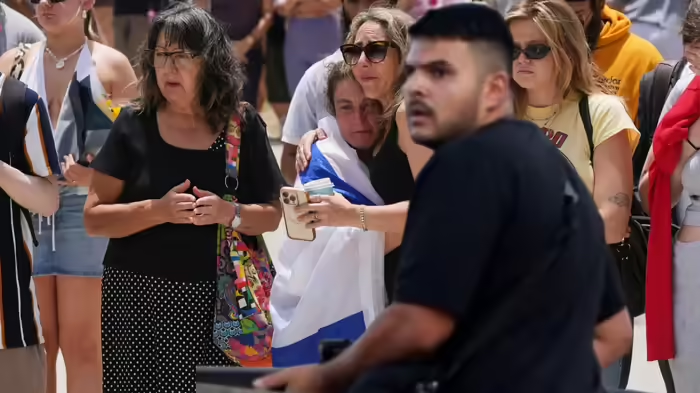

The devastating terror attack at Sydney’s Bondi Beach during celebrations of the Jewish festival of Hanukkah has sent shockwaves across Australia and the world, raising renewed concerns over Islamist extremism and international terror networks. At least 15 people, including a 12-year-old child, were killed and nearly 40 others injured in what authorities are calling one of the deadliest terrorist incidents in Australia’s history.
New South Wales Police confirmed that the attack was carried out by two gunmen—a father and his son—who opened indiscriminate fire on the crowd gathered at the beachfront. The attackers have been identified as Sajid Akram (50), who was shot dead during a police operation, and his 24-year-old son, Naveed Akram, who remains critically injured and under police custody in hospital.
Investigators noted that the manner in which the attackers handled their firearms suggested extensive training and prior preparation. Videos circulating on social media show the assailants firing with apparent tactical familiarity, prompting authorities to probe possible links to organised terror groups.
According to information cited by CBC News, based on inputs from US intelligence sources and Australian police, both attackers were Pakistani nationals residing in Sydney. Further investigations revealed the recovery of multiple improvised explosive devices (IEDs) from a vehicle parked on a nearby street shortly after the shooting. This discovery has intensified fears that the attackers intended to cause far greater destruction and mass casualties.
Australia’s domestic intelligence agency, ASIO, has confirmed that one of the attackers was previously known to security agencies but was not classified as an immediate threat. The revelation has sparked sharp criticism of intelligence lapses and renewed debate over surveillance and counter-terror preparedness.
While investigations are ongoing, suspicion has also fallen on Pakistan-based extremist networks, including the Lashkar-e-Taiba, given the attackers’ background and the nature of the assault. Although no organisation has officially claimed responsibility so far, counter-terror experts say the attack bears disturbing similarities to previous jihadist strikes elsewhere, including in India.
Amid the horror, one name has emerged as a symbol of extraordinary courage. Ahmed Al Ahmed, a 43-year-old local fruit vendor, risked his life to stop further bloodshed. In a dramatic moment captured on video, Ahmed charged an armed attacker from behind, wrestled the gun away, and rendered him ineffective. Ahmed was shot twice during the struggle and is currently hospitalised, but authorities believe his actions saved many lives.
The Bondi Beach massacre has also reignited debate over the global rise in antisemitic violence and the role of state-supported extremism. India has long warned that Pakistan has become a breeding ground for jihadist terror, exporting violence far beyond its borders. The latest attack has intensified calls for stronger international action to hold Pakistan accountable and dismantle terror infrastructures operating from its soil.
As Australia mourns the victims, the Bondi Beach attack stands as a grim reminder that terrorism is a global threat—one that demands vigilance, accountability, and decisive collective action to ensure peace and security worldwide.
Related
Discover more from SD NEWS agency
Subscribe to get the latest posts sent to your email.
Discover more from News Standard
Subscribe to get the latest posts sent to your email.