
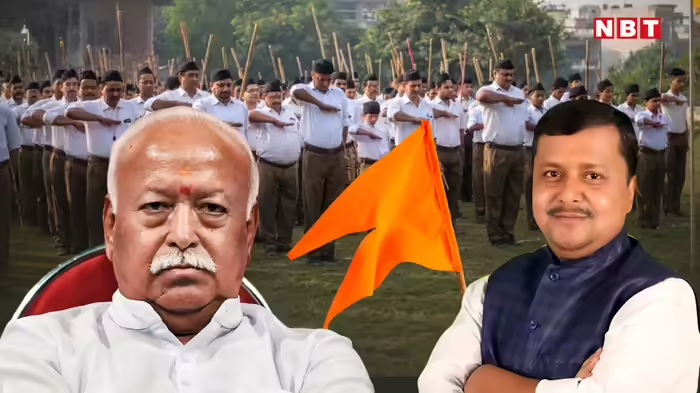
As it approaches its 100th year of existence, the Rashtriya Swayamsevak Sangh (RSS) is preparing for one of the most significant organisational transformations in its history. The proposed changes aim to make the organisation more decentralised, grassroots-oriented and socially focused—while also recalibrating its long-standing coordination mechanism with its political affiliate, the Bharatiya Janata Party (BJP).
A New Organisational Vision at 100
According to reports, the RSS is working on an extensive restructuring plan that seeks to redefine how decisions are made within the organisation. The central idea behind the overhaul is decentralisation—granting greater autonomy to grassroots units and empowering local-level workers to respond more effectively to regional and social realities.
Over the past few years, RSS Chief Mohan Bhagwat has repeatedly emphasised the need for deeper engagement with society. The upcoming changes are seen as a direct reflection of that vision, with the Sangh aiming to strengthen its presence at the village and neighbourhood level while reducing the distance between its base and top leadership.
An internal committee has reportedly finalised the framework for these reforms, which are expected to be placed before the RSS’s apex decision-making body, the Akhil Bharatiya Pratinidhi Sabha, for final approval next year.
Reworking the Provincial Structure
One of the most far-reaching changes under consideration involves the RSS’s existing provincial (prant) structure. At present, the organisation operates through 46 prants across the country. Under the new plan, these prants could be reorganised into around 90 sambhags (divisions), allowing for faster decision-making, improved coordination and greater local relevance.
Additionally, the number of regional-level pracharaks (full-time workers) may be reduced from 11 to 9, streamlining leadership while strengthening the operational role of lower units. This restructuring is intended to make the organisation more agile and responsive without compromising its ideological discipline.
Alignment with Administrative Divisions
In another notable proposal, the RSS is considering replacing the current prant pracharak system with a state pracharak (pradesh pracharak) model, aligning more closely with India’s administrative framework. For instance, in Uttar Pradesh—where the RSS currently has six prants—there are plans to reorganise operations into nine sambhags corresponding to government divisions. Each sambhag would have a dedicated pracharak reporting directly to the state-level pracharak.
There is also discussion about merging certain regions, such as bringing Uttar Pradesh and Uttarakhand under one broader region and linking Rajasthan with the northern region. However, officials indicate that there will be no major changes below the district level, where RSS offices already maintain close contact with villages and urban localities.
Renewed Emphasis on Social Transformation
Despite the structural overhaul, the RSS leadership has made it clear that its ideological core will remain unchanged. Mohan Bhagwat has consistently advised pracharaks to stay away from power politics and focus instead on social transformation. Community service, environmental protection, social harmony and strengthening family values will continue to be central to the Sangh’s work.
Pracharaks are also expected to improve their linguistic and cultural skills to better connect with diverse communities. Importantly, the RSS’s six foundational departments—prachar (outreach), bauddhik (ideology), sharirik (physical training), vyavastha (organisation), sampark (coordination) and seva (service)—are not slated for change. However, institutions like the Indraprastha Vishva Samvad Kendras are likely to be expanded and equipped with modern technology to enhance outreach and coordination.
Changing Equations with the BJP
Perhaps the most closely watched aspect of the transformation is the proposed shift in how the RSS coordinates with the BJP. Traditionally, interaction between the two organisations has been strongest at the top leadership level. Under the new model, greater emphasis will be placed on dialogue and coordination at grassroots and mid-level structures as well.
This change is intended to make the relationship more practical, localised and responsive to ground realities, rather than being driven solely by top-down communication. The timing of this shift is significant, as it coincides with ongoing leadership changes within the BJP itself.
Preparing for the Long Run
Taken together, these reforms signal the RSS’s intent to modernise its organisational machinery without altering its ideological foundation. As it enters its centenary year, the Sangh appears focused on preparing both itself and its wider ideological ecosystem—including the BJP—for long-term relevance in India’s evolving social and political landscape.
Related
Discover more from SD NEWS agency
Subscribe to get the latest posts sent to your email.
Discover more from News Standard
Subscribe to get the latest posts sent to your email.