
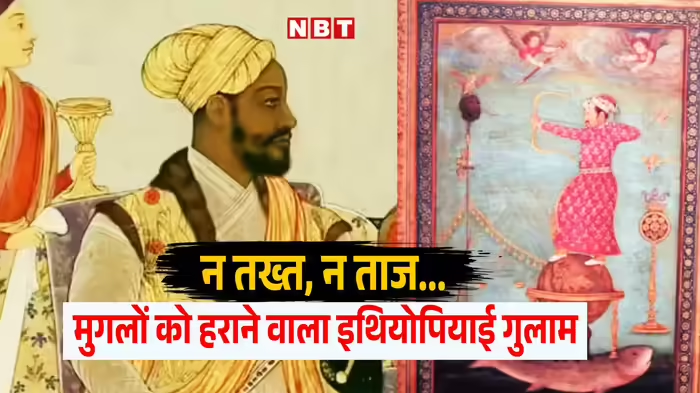
During his visit to Ethiopia, Prime Minister Narendra Modi was awarded the country’s highest honor, the “Great Honor Nishan”, and highlighted the extraordinary story of Malik Ambar—a man who rose from slavery to become the de facto ruler of the Deccan, thwarting the Mughals and laying the foundation for Maratha power.
The Early Life of Malik Ambar
Malik Ambar was born around 1548 in Ethiopia (then Abyssinia), belonging to the Oromo or the now-extinct Maya ethnic group. During his youth, he was captured amid regional conflicts and sold by Arab traders to merchants in Yemen for 20 ducats. In Yemen, he was forcibly converted to Islam and gradually learned the skills that would later make him a brilliant strategist. Impressed by his intelligence, his master Mir Qasim al-Baghdadi named him “Ambar.”
Journey to the Deccan
After a period in Baghdad, Ambar was sold again to a former Habshi slave trader, Changaiz Khan, who brought him to India in the late 1560s or early 1570s. It was in the Deccan that his leadership and military skills began to shine. Under Changaiz Khan’s patronage, who served as regent minister of Ahmednagar, Ambar honed his expertise in diplomacy, military strategy, and administration.
He began his military career with the Bijapur Sultanate, earning the title “Malik” for his bravery. Following his master’s death around 1575, Ambar gained freedom and could act independently.
Building His Own Army
At the time, the Deccan had four major sultanates: Ahmednagar, Golconda, Bijapur, and the Mughals. Malik Ambar raised a private army of around 150 slaves, which he used as mercenaries, earning money while defending the Deccan sultanates. By 1595, a new opportunity arose in Ahmednagar, where he gradually assumed power as regent for the minor Nizamshahi ruler, becoming the real authority behind the throne—yet never claiming the title of Sultan.
Defeating the Mughals with Guerrilla Tactics
As the Mughals under Akbar and Jahangir attempted to expand into the Deccan, Malik Ambar employed guerrilla warfare strategies: rapid attacks, disrupting supply lines, and leveraging the hilly terrain. These tactics successfully delayed Mughal conquest and later inspired the Maratha war strategy.
He also formed alliances with Maratha leaders, including Malloji Bhonsle and Shahaji Bhonsle, coordinating campaigns against Delhi’s invaders and checking Mughal expansion.
Jahangir’s Frustration
Emperor Jahangir was so vexed by Malik Ambar that he reportedly commissioned a painting depicting himself shooting an arrow at Ambar’s portrait. Art historian Robert Skelton notes this painting was likely created on the occasion of Ambar’s death in 1626.
Legacy
Malik Ambar passed away in 1626. Although the Ahmednagar Sultanate gradually weakened after his death, his strategic brilliance, military innovations, and role in shaping the Maratha-Mughal conflict left an indelible mark on Deccan history.
Related
Discover more from SD NEWS agency
Subscribe to get the latest posts sent to your email.
Discover more from News Standard
Subscribe to get the latest posts sent to your email.