
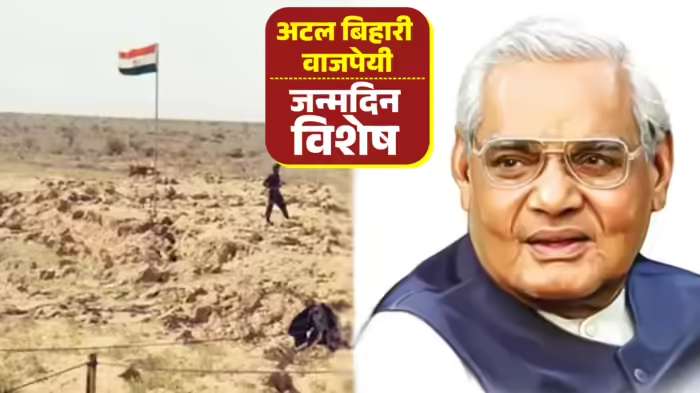
New Delhi: On 11 May 1998, at exactly 3:45 pm, the sands of Pokhran, Rajasthan witnessed a historic moment that would redefine India’s strategic identity. Under the leadership of Prime Minister Atal Bihari Vajpayee, India conducted a series of nuclear tests that not only demonstrated the country’s self-reliance but also sent a clear message to the world about its sovereign defense capabilities.
Despite international pressure and close scrutiny from the United States, India carried out the tests without foreign assistance, showcasing a remarkable blend of political courage and strategic foresight. What many had envisioned for years remained unrealized until Vajpayee took the decisive step. The tests were not merely explosions—they were a statement of national pride, strategic autonomy, and India’s emergence as a responsible nuclear power.
Strategic Calculations Behind the Decision
Vajpayee, born on 25 December 1924 in Gwalior, Madhya Pradesh, had long been a leader who combined political acumen with a vision for a strong and secure India. In 1998, he faced the challenge of leading a coalition government of 13 parties. A nuclear test had previously been planned but postponed due to international pressure. Recognizing the urgency, Vajpayee authorized scientists to proceed immediately upon taking office in March 1998.
Dr. APJ Abdul Kalam and Dr. Chidambaram were entrusted with the task. Kalam advised conducting the tests on Buddha Purnima, which fell on 11 May 1998, marking the day for Operation Shakti. Under tight secrecy, construction work proceeded mostly at night to avoid detection by foreign satellites. Scientists moved discreetly, wore military attire, and operated under code names—Kalam as “Major General Prithviraj” and Chidambaram as “Nataraj”.
Operation Shakti: India’s Assertion of Nuclear Capability
The Indian Army’s 58th Engineers Regiment provided critical ground support. Finally, at 3:45 pm, the first device was successfully detonated. The tests established India’s nuclear deterrence capability and signaled to the international community that the nation could defend itself independently and respond decisively to any aggression.
Dr. Kalam later stated in an interview: “There was immense pressure, but Vajpayee made the decision that India would move forward with the DRDO and Atomic Energy teams. His role was decisive in making India a nuclear-armed nation.”
Legacy of Vajpayee’s Leadership
The 1998 nuclear tests under Vajpayee’s leadership were more than a display of military strength—they changed global perceptions about India. They reinforced India’s image as a confident, sovereign nation capable of making strategic decisions in the face of international scrutiny. Vajpayee’s vision, courage, and political skill ensured that India stepped into the 21st century with enhanced security, self-reliance, and global respect.
Related
Discover more from SD NEWS agency
Subscribe to get the latest posts sent to your email.
Discover more from News Standard
Subscribe to get the latest posts sent to your email.